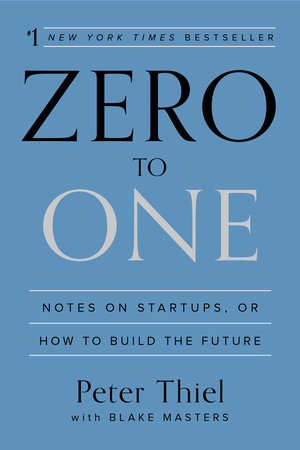
Zero to One: Notes on Startups, or How to Build the Future
, Business, 2014
The argument that durable company value comes from building a differentiated, creative monopoly — not competing as a commodity or copying someone else's formula.
About the book
Adapted from Thiel's Stanford startup lectures, the book organizes a contrarian operating framework around monopoly, definite optimism, founder control, sales, and the question of what valuable company nobody is building. Founders 31 pairs it with Conspiracy; Founders 278 rereads it directly.
Why it matters in Founders
Zero to One's central claim is that durable companies are built by creating something new rather than competing in a crowded field: a creative monopoly, deliberately built by a founder who is a definite optimist. It returns to a first-principles argument that success comes from rethinking a problem from scratch rather than copying a formula, and to the point that most business value lies in future profits, so durability matters more than early growth.
That argument extends past the product itself: the book treats recruiting as a core competency a company cannot outsource, and treats founding as lasting only as long as the company keeps creating new things. Differentiation, distribution, durability, and recruiting become one connected question about where a founder's value comes from and whether it holds.
What you’ll learn
Differentiation over commodity competition
Thiel's warning is that undifferentiated commodity businesses do not make money. The question the book leaves a founder with is whether the company is doing something no one else is, or competing on the same terms as everyone.
Creating value is not capturing it
The book separates creating something valuable from capturing the value it creates. A founder has to answer both questions, not just the first.
Sales and distribution count as much as product
Thiel argues that superior sales and distribution can create a monopoly even without product differentiation, and that they are essential even for strong products. Distribution is not an afterthought.
Why it ranks here
Reading rank #5. First covered in Episode #31. 63 scored evidence components. 49 Founders episodes. Coverage Score 476. Praise on record: David says Zero to One has almost no fluff and is packed with useful ideas.
Explore evidence and score breakdownOpen timeline
How the Coverage Score works
Reviewed Founders evidence adds points: a dedicated episode, a qualifying reread, explicit praise, or a reference in a later episode. Repeats of the same kind in one independently recorded discussion count once, including reviewed reused passages. Genuinely new qualifying discussion adds points. The score measures coverage, not quality.
Sources: official Founders episodes — #30, #31, #157, #174, #181, #188, #190, #192, #197, #200, #202, #206, #213, #217, #228, #244, #275, #278, #279, #280, #282, #291, #307, #321, #323, #324, #325, #329, #330, #331, #339, #343, #345, #350, #373, #383, #400, #416, #419, #423, #424, #425, #426, #427, #428, #430, #431, #433, #434
The largest contribution to this Coverage Score is Dedicated episode · Primary coverage (135 points).
Original Founders sources
- Elon Musk: Tesla, SpaceX, and the Quest for a Fantastic Future — David applies Zero to One's differentiation argument to recruiting, emphasizing the need to explain why a particular company is uniquely suited to a candidate.
- Conspiracy: Peter Thiel, Hulk Hogan, Gawker, and the Anatomy of Intrigue and Zero to One: Notes on Startups, or How to Build the Future — The episode explicitly centers on Conspiracy and Zero to One, with its second major section devoted to Thiel's startup principles.
- The Innovators: How a Group of Hackers, Geniuses, and Geeks Created the Digital Revolution — David applies Zero to One's argument that computers and people should complement one another rather than compete.
- Bill Gates (Overdrive) — David uses a Zero to One quote to connect successful business thinking to first principles rather than copying formulas.
- Paul Orfalea (Kinkos) — David references Zero to One's argument that advertising works on everyone.
- Joe Coulombe (Founder of Trader Joes) — David compares Joe's view of convenience retailing as an undifferentiated commodity business to Peter Thiel's warning against commodity businesses in Zero to One.
Explore connections
People, companies, and ideas linked to this book across Founders episodes. Choose one to see it on the map.
Numbers show how many other books share that connection.