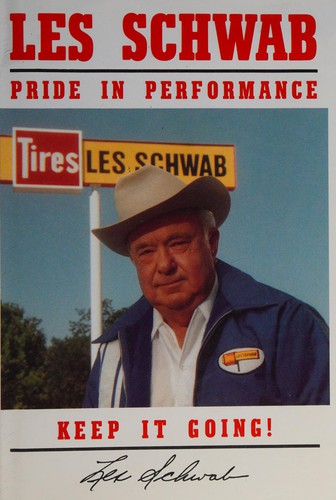
Les Schwab Pride in Performance: Keep It Going
, Autobiography, 1986
A founder’s account of retail operations that puts employee stake and the customer’s in-store experience in the foreground.
About the book
First published in 1986 and expanded by three chapters for the 1996 third printing shown here, Schwab's self-written autobiography traces his path into tire retail and sets out the operating policies he wanted the company to preserve: share store profits, pay for quality, promote from within, keep decisions close to customers, and resist complacency.
Reading perspective
Schwab recounts building his tire-retailing company from the founder's chair. The memoir is organized around the operating policies he set at the level of the individual store.
What you’ll learn
Tie a store’s share to its own results
The company used profit sharing linked to each individual store’s profits. It is a specific arrangement to consider when deciding how closely rewards should follow a local unit’s performance.
Make inventory part of the sales conversation
The supermarket-style showroom displayed warehouse inventory, giving employees tangible options to explain while customers selected tires.
Editorial sources
Book guidance draws on these sources; Founders evidence determines the ranking.
Why it ranks here
Reading rank #28. First covered in Episode #105. 23 scored evidence components. 11 Founders episodes. Coverage Score 253. Praise on record: Host praises the book and recommends it to business operators, noting Charlie Munger's endorsement.
Explore evidence and score breakdownOpen timeline
How the Coverage Score works
Reviewed Founders evidence adds points: a dedicated episode, a qualifying reread, explicit praise, or a reference in a later episode. Repeats of the same kind in one independently recorded discussion count once, including reviewed reused passages. Genuinely new qualifying discussion adds points. The score measures coverage, not quality.
Sources: official Founders episodes — #105, #172, #181, #192, #197, #203, #231, #244, #330, #353, #360
The largest contribution to this Coverage Score is Dedicated episode · Primary coverage (90 points).
Original Founders sources
- Les Schwab (Charlie Munger recommended this book) — David applies Schwab's preference for owning property to businesses dependent on platforms such as YouTube, drawing a lesson about control over the foundation of a business.
- Elon Musk (Early Days of SpaceX) — David connects the Les Schwab incentive lesson to Founders episode 105.
- Paul Orfalea (Kinkos) — David identifies Les Schwab's autobiography and points listeners to Founders #105.
- Jim Casey (Founder of UPS) — David identifies Les Schwab's autobiography as Founders #105.
- Founder of the Rothschild Family Dynasty — David says he reread highlights from Les Schwab's autobiography and approximately identifies it as Founders episode 105.
- Georges Doriot (Birth of Venture Capital) — David uses Schwab's profit sharing and employee mentoring to explain Doriot's people-building idea.