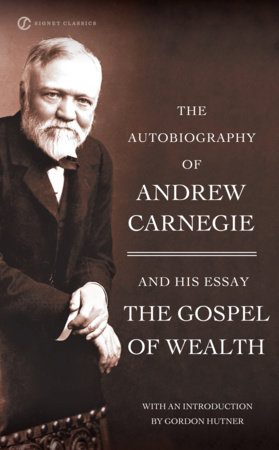
The Autobiography of Andrew Carnegie
, Autobiography, 1920
A self-portrait of advancement that also invites scrutiny of how success stories assign credit and explain judgment.
About the book
Carnegie began the memoir in retirement for family and friends, and it breaks off at the outbreak of war, as a preface by his wife Louise explains. He credits a radical weaving family in Dunfermline, Colonel Anderson's library for working boys and the mentorship of Thomas Scott at the Pennsylvania Railroad, and later chapters take up labor problems and the Gospel of Wealth.
Reading perspective
Carnegie recounts his rise through family influence, access to books, and professional mentorship, while presenting his own views on business and labor. The memoir is useful for examining how an industrial leader frames responsibility, opportunity, and personal character from the vantage point of retirement.
What you’ll learn
Know costs at each stage, not only at year end
Carnegie describes finding that process costs were unknown until the annual accounts, and introducing weighing and record-keeping for materials and each stage of production. He also notes that producing accurate figures took years.
Separate technical skill from business responsibility
In discussing Andrew Kloman, Carnegie distinguishes mechanical talent from office and business work. The distinction gives readers a practical way to examine whether an evaluation is measuring the abilities a role actually requires.
Editorial sources
Book guidance draws on these sources; Founders evidence determines the ranking.
Why it ranks here
Reading rank #49. First covered in Episode #74. 21 scored evidence components. 14 Founders episodes. Coverage Score 207. Praise on record: David recommends Carnegie's autobiography among the books from his earlier Carnegie/Frick coverage.
Explore evidence and score breakdownOpen timeline
How the Coverage Score works
Reviewed Founders evidence adds points: a dedicated episode, a qualifying reread, explicit praise, or a reference in a later episode. Repeats of the same kind in one independently recorded discussion count once, including reviewed reused passages. Genuinely new qualifying discussion adds points. The score measures coverage, not quality.
Sources: official Founders episodes — #73, #74, #75, #78, #181, #228, #234, #279, #283, #284, #353, #384, #385, #394
The largest contribution to this Coverage Score is Dedicated episode · Primary coverage (90 points).
Original Founders sources
- Andrew Carnegie and Henry Clay Frick: The Bitter Partnership That Changed America — David previews a forthcoming episode on The Autobiography of Andrew Carnegie.
- The Autobiography of Andrew Carnegie — David contrasts the autobiography with the preceding Carnegie–Frick episode, focusing this discussion on material unique to the autobiography.
- Henry Clay Frick: Andrew Carnegie's Partner — David identifies the previous episode as his discussion of Andrew Carnegie's autobiography.
- Charlie Munger (the Tao of Charlie Munger) — David attributes Carnegie's concentrated-effort idea to the autobiography while acknowledging it may instead be in Meet You in Hell.
- Paul Orfalea (Kinkos) — David draws on an idea from Andrew Carnegie's autobiography about judging yourself rather than relying on others' judgment, applying it to Orfalea's story.
- Michael Bloomberg — David connects Carnegie's autobiography and earlier three-part coverage to Bloomberg's technological competitive advantage.