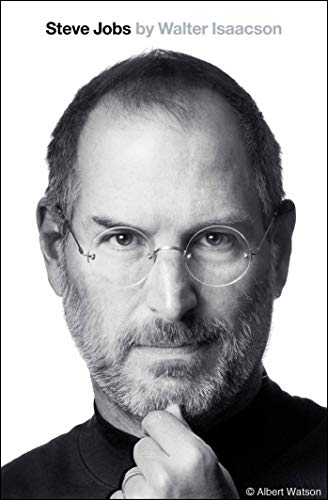
Steve Jobs
, Biography, 2011
Isaacson's whole-life biography of Jobs, a portrait of a founder who was both exemplary and deeply flawed.
About the book
Built from more than forty interviews with Jobs and more than one hundred interviews with family, friends, colleagues, and competitors, the book was produced with Jobs’s cooperation but without his control over its contents. Isaacson presents both Jobs’s product vision and the personal costs of his abrasive management style.
Why it matters in Founders
The book's value is its combination of achievement and contradiction: Jobs is presented as an extraordinary builder whose product judgment and company-building lessons cannot be separated from his serious personal flaws. Two of its recurring ideas are Jobs's insistence on simplicity and his closing advice about building a company meant to last.
David has reread the biography in full, spending more than twenty hours on it, and calls it probably the first book he would recommend for studying the history of entrepreneurship.
What you’ll learn
Build a company meant to last
Jobs's closing advice in the biography is about building a durable company rather than a run of products. Another passage in the book makes the same case for building something that endures.
Recruit the way Oppenheimer did
Jobs describes building teams of top talent on an Oppenheimer-inspired model, drawn from Isaacson's biography. It raises the question of how deliberately a founder should assemble talent, rather than letting a team form around immediate needs.
Two questions before the work
The book offers a two-part decision test: do you care about the work, and is it good for the world. It is a short filter for deciding what to take on next.
Why it ranks here
Reading rank #13. First covered in Episode #5. 38 scored evidence components. 24 Founders episodes. Coverage Score 355. Praise on record: David calls this probably the first book he'd recommend for studying entrepreneurship history.
Explore evidence and score breakdownOpen timeline
How the Coverage Score works
Reviewed Founders evidence adds points: a dedicated episode, a qualifying reread, explicit praise, or a reference in a later episode. Repeats of the same kind in one independently recorded discussion count once, including reviewed reused passages. Genuinely new qualifying discussion adds points. The score measures coverage, not quality.
Sources: official Founders episodes — #5, #8, #19, #29, #40, #76, #77, #102, #105, #126, #133, #155, #157, #178, #187, #202, #204, #212, #214, #216, #218, #238, #259, #302
The largest contribution to this Coverage Score is Dedicated episode · Primary coverage (90 points).
Original Founders sources
- Steve Jobs — The episode is structured as a dedicated discussion of Walter Isaacson's Steve Jobs biography.
- The Intel Trinity: How Robert Noyce, Gordon Moore, and Andy Grove Built the World's Most Important Company — David credits Isaacson's Steve Jobs biography as the source through which he discovered Robert Noyce, framing this episode as a book-led chain of discovery.
- Becoming Steve Jobs — David points back to his earlier coverage of Walter Isaacson's Steve Jobs biography while introducing Becoming Steve Jobs.
- The HP Way: How Bill Hewlett and I Built Our Company — David had previously covered Walter Isaacson's Steve Jobs on Founders; that book's repeated references to Hewlett and Packard led him to discover The HP Way.
- Insisting On The Impossible: The Life of Edwin Land and Instant: The Story of Polaroid — David uses Isaacson's account of Jobs and Edwin Land to connect entrepreneurship with the intersection of the humanities and sciences.
- Steve Jobs: The Early Years of Apple — Host notes he previously covered Walter Isaacson's Steve Jobs biography, contrasting its whole-life scope with this book's narrower focus.
Explore connections
People, companies, and ideas linked to this book across Founders episodes. Choose one to see it on the map.
Numbers show how many other books share that connection.