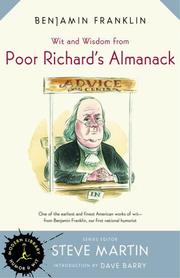
Poor Richard's Almanack
, subject: Benjamin Franklin's annual almanac and practical maxims on industry, frugality, prudence, and conduct, 1732
Franklin's almanac turned wisdom gathered from many ages into short, witty maxims about industry, frugality, and what moves people to act.
About the book
Beginning in 1732 with an almanac for 1733, Franklin used Poor Richard to circulate practical maxims and adapted wisdom; the series continued through 1758 and later supplied the model for the almanacs associated with Charlie Munger and Naval Ravikant.
Why read it
Best if you want short, practical rules about work, thrift, and incentives, and are interested in how sharp phrasing makes an old idea easy to remember and use.
Key themes
- Making old wisdom memorable
- Discipline and incentive
Evidence and original sources
Sources: official Founders episodes — #90, #115, #182, #191, #229, #251
This record is supported by 6 public evidence rows linked to original Founders episodes.
- Charlie Munger (Poor Charlie's Almanack) — David reads Buffett's comparison between Franklin and Munger, naming thrift, duty, hard work, and simplicity, then later uses Franklin's maxim about appealing to interest to explain the power of incentives.
- Ben Franklin: An American Life — David describes Poor Richard's Almanack as one of Franklin's extraordinarily successful publishing products and explains that Franklin adapted wisdom from many ages into memorable maxims rather than claiming every saying as original.
- Warren Buffett (The Making of an American Capitalist) — David reads a comparison of Warren Buffett's topical, practical shareholder letters to a Harvard Business School syllabus delivered in the spirit of Franklin's Poor Richard's Almanack.
- Naval Ravikant (A Guide to Wealth and Happiness) — David traces the title and aphoristic form of The Almanack of Naval Ravikant through Poor Charlie's Almanack to Franklin's Poor Richard's Almanack, emphasizing how maxims make practical ideas memorable and reusable.
- Sidney Harman (Founder of Harman Kardon) — David identifies Sidney Harman's concluding 'Sidney's Almanac' as part of the naming and maxims tradition that runs through Franklin's Poor Richard's Almanack and Charlie Munger's almanac.
- Ben Franklin and George Washington: The Founding Partnership — David describes Franklin's annual almanac as witty commentary and practical advice with remarkable reach, then quotes its enduring instruction to use industry and frugality and waste neither time nor money.