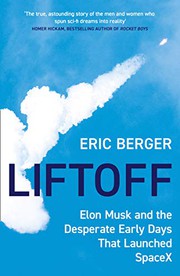
Liftoff: Elon Musk and the Desperate Early Days That Launched SpaceX
, History, 2021
Berger’s account of early SpaceX shares the credit between Musk’s drive and the recruited engineers who built parts, wrote flight software and worked from a remote launch site.
About the book
Berger, an editor at Ars Technica, credits the company's survival to the scientists and engineers recruited from academia and industry as well as to Elon Musk's drive. He frames early SpaceX as part of a shift in which private firms took on work long held by government agencies such as NASA.
Reading perspective
Berger follows SpaceX from 2002 to Falcon 1’s successful flight in 2008, drawing on early employees and Musk. He presents a private firm taking on work long associated with government space agencies, with credit shared between Musk’s focus and the people recruited from academia and industry.
What you’ll learn
Musk took the hardest engineering problems first
Berger describes Musk as tending to take on the hardest engineering problems first. Take this as a case-specific approach to sequencing technical work, not a rule that every project should follow.
Look beyond the launch result
The early team’s work included manufacturing parts and writing flight-computer software, with some work taking place at Kwajalein. The account encourages attention to the fabrication, software, and remote-site work behind a visible flight attempt.
Editorial sources
Book guidance draws on these sources; Founders evidence determines the ranking.
Why it ranks here
Reading rank #53. First covered in Episode #172. 17 scored evidence components. 12 Founders episodes. Coverage Score 201. Praise on record: David praises the book as short and extremely readable, saying he tore through it because he found it engaging.
Explore evidence and score breakdownOpen timeline
How the Coverage Score works
Reviewed Founders evidence adds points: a dedicated episode, a qualifying reread, explicit praise, or a reference in a later episode. Repeats of the same kind in one independently recorded discussion count once, including reviewed reused passages. Genuinely new qualifying discussion adds points. The score measures coverage, not quality.
Sources: official Founders episodes — #172, #174, #175, #233, #327, #329, #330, #331, #345, #352, #354, #369
episode #354 reuses discussion from episode #352. For each evidence type, the strongest qualifying component counts once per discussion. Source publication and scoring origin are separate.
The largest contribution to this Coverage Score is Dedicated episode · Primary coverage (90 points).
Original Founders sources
- Elon Musk (Early Days of SpaceX) — David identifies Liftoff by Eric Berger as the book featured in this episode.
- Bill Gates (Overdrive) — David explicitly returns to the recent Founders episode and Liftoff for the example of Elon Musk personally interviewing SpaceX's first 3,000 employees to limit talent dilution as the company grew.
- Theodore Roosevelt's Darkest Journey — David identifies Founders 172 and the book Liftoff as the source of the SpaceX example he is reusing.
- Elon Musk, Peter Thiel, Max Levchin (PayPal) — David says the first-six-years history of SpaceX covered in Liftoff is also in the Founders archive.
- Ted Turner — David draws a recruiting lesson from Liftoff: solve practical barriers that prevent an identified high-value candidate from joining.
- Charlie Munger (the NEW Poor Charlie's Almanack) — David draws a solve-the-recruit's-problem founder theme from Liftoff's SpaceX hiring story.