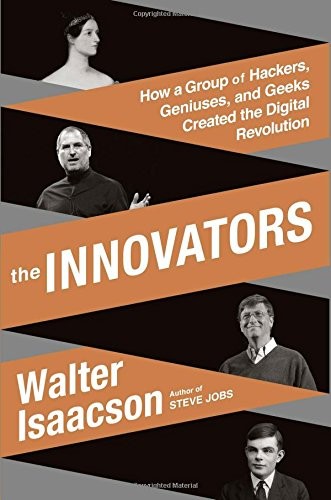
The Innovators: How a Group of Hackers, Geniuses, and Geeks Created the Digital Revolution
, subject: History of the digital revolution through Ada Lovelace, computing, semiconductors, software, internet pioneers, and collaborative innovation, 2014
The Innovators treats innovation as building on earlier ideas, as when Apple improved and marketed Xerox's work and AOL scaled on simplicity and free samples.
About the book
Isaacson traces three developments: the computer itself, beginning with Ada Lovelace and Charles Babbage; Silicon Valley's cooperative, nonhierarchical working culture; and the consumer demand that led to personal devices. His argument is that innovation comes from groups of peers who share ideas, not from lone inventors.
Why read it
Best if you want to understand why improving, simplifying and distributing an idea can matter as much as inventing it, and how to weigh the people behind a venture.
Key themes
- The advantage often goes to whoever develops an idea
- Easy to use and easy to try
- The people behind an idea are part of the bet
Evidence and original sources
Sources: official Founders episodes — #157, #159, #165, #204, #270
This record is supported by 14 public evidence rows linked to original Founders episodes.
- The Innovators: How a Group of Hackers, Geniuses, and Geeks Created the Digital Revolution — Episode is built around Walter Isaacson's The Innovators.
- Andy Grove (Intel) — David identifies The Innovators as the book that led him to Andy Grove's autobiography.
- William Shockley (Creator of the Electronic Age) — David notes Shockley previously appeared in The Innovators, covered on Founders #157.
- Steve Jobs (Inside Steve's Brain) — David names The Innovators as the source of the Andy Grove anecdote used in the episode.
- Vannevar Bush (Pieces of the Action) — David connects this book to Founders episode 157.